
Lessons from a Golf Genius: Learning from Ben Doyle at Quail Lodge
There are golf instructors.
And then there was Ben Doyle.
Growing up on the Monterey Peninsula, golf consumed my life. I played at Spyglass Hill, Pebble Beach Golf Links, Poppy HIll Golf Course, Pasatiempo Golf Club and Seascape Golf Course whenever I could, caddied there on weekends, and spent every spare moment trying to become a better player. Like most young golfers, I wanted to know the secret. I wanted someone to tell me the magic move that would unlock a better golf swing.
Instead, I found Ben Doyle.
Ben taught out of Quail Lodge Golf Club in Carmel Valley, and looking back now, I realize I had no idea how fortunate I was. At the time, I simply knew he had a legendary reputation. Today, I understand that I was learning from arguably the greatest interpreter of Homer Kelley's The Golfing Machine and one of the finest golf instructors the game has ever produced.
His reputation stretched far beyond amateur golfers. One of his most famous students was PGA Tour major champion Steve Elkington, whose swing was widely regarded throughout the 1990s as the best in professional golf. I've heard stories that when Elkington was in California, he'd helicopter down from the San Francisco area just to spend time with Ben before returning to tournament preparations. When one of the purest ball strikers in the world is willing to travel that way for a lesson, it tells you everything you need to know about the teacher.
The funny thing was, if you didn't know who Ben was, you probably would have driven right past him.
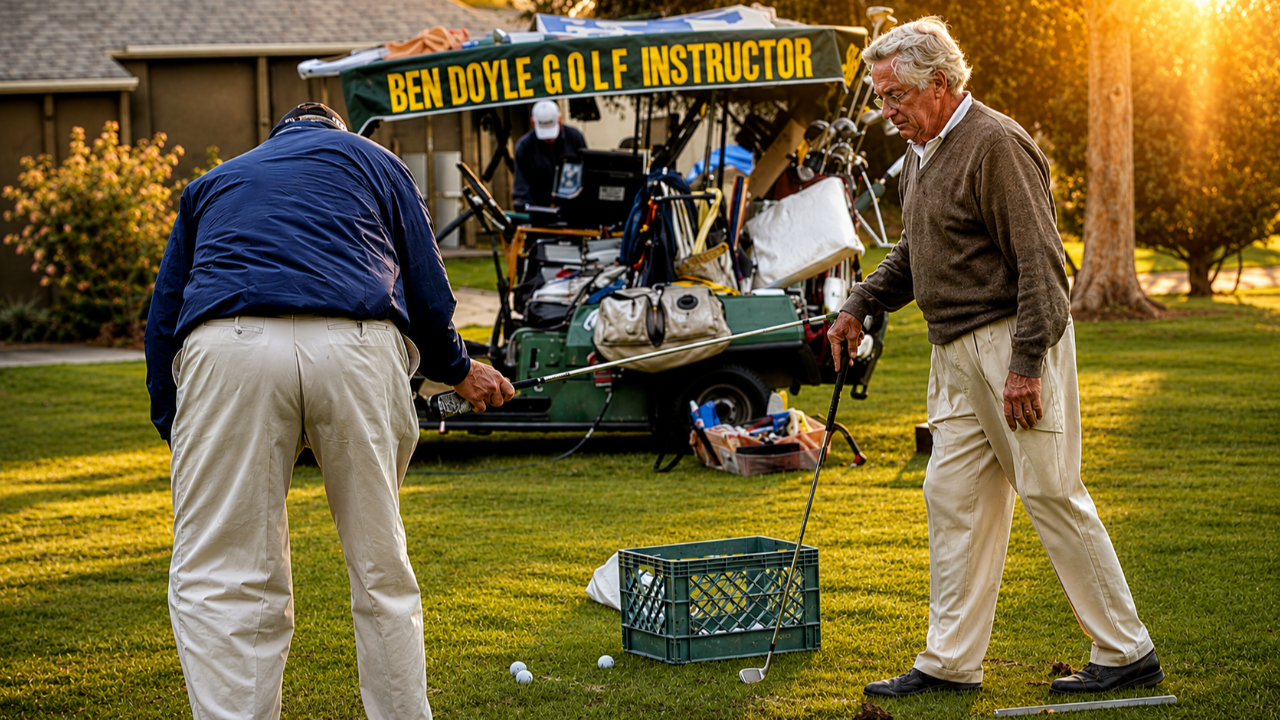
Every lesson began with Ben bouncing across the practice tee in an old maintenance golf cart that looked like it belonged to the grounds crew. It wasn't loaded with the latest clubs or shiny teaching gadgets. Instead, it overflowed with broom handles, PVC pipe, homemade clubs, ropes, wooden blocks, rubber tubing, and every imaginable training aid he had built himself over the years. To the average golfer, it looked like a rolling pile of junk.
To Ben, every piece served a purpose.
He wasn't interested in showing you positions. He wanted you to feel what the golf club was supposed to do.
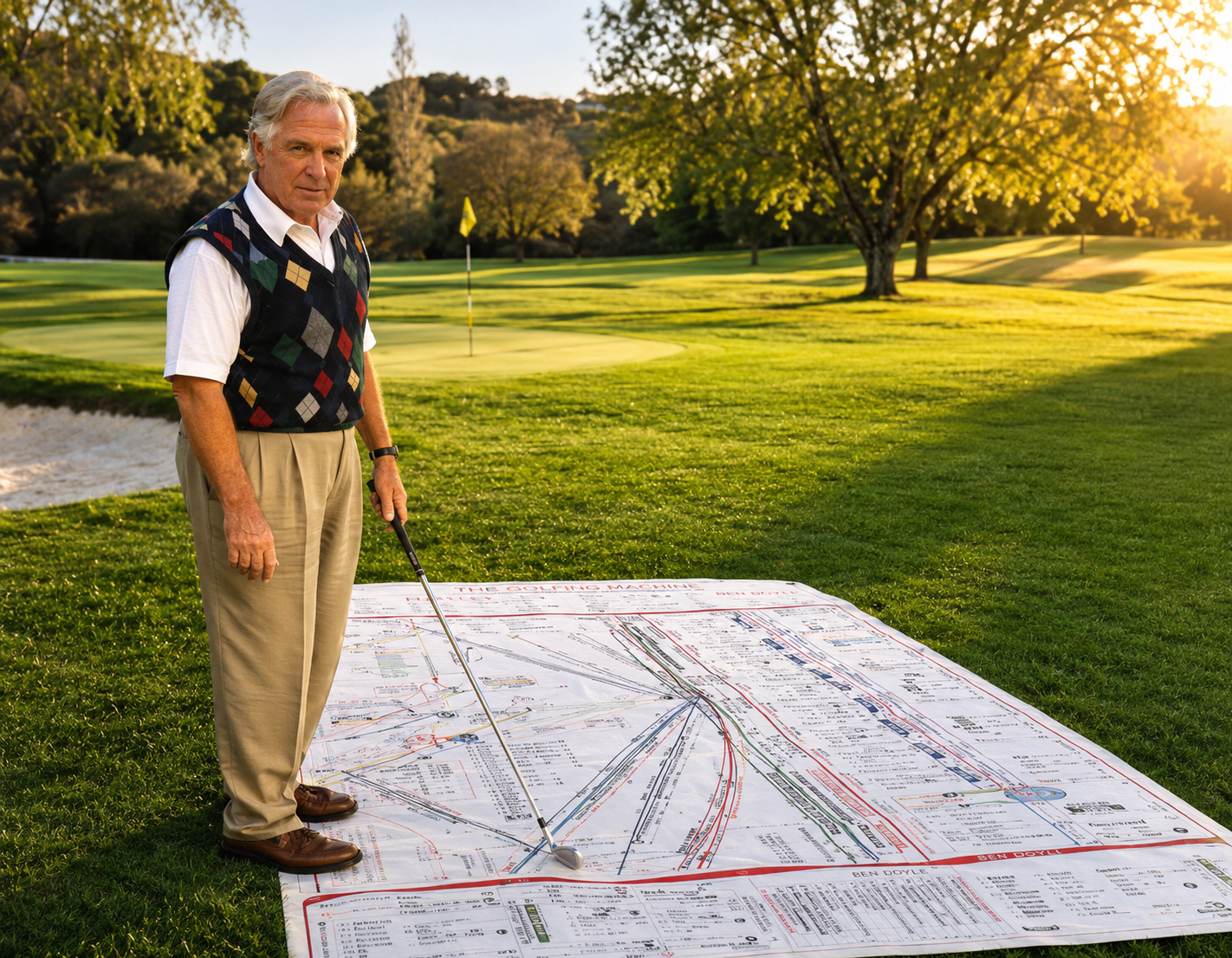
That philosophy extended to everything around him, including his famous practice mat. Ben had somehow managed to print nearly every concept he'd ever learned about the golf swing onto one piece of turf. Swing planes, pressure points, impact alignments, geometry, arrows, notes, reminders—it was all there. Buried within the chaos were absolute nuggets of instructional gold.
The problem was that there was so much information packed onto that mat it could make your head spin.
Looking back, that mat perfectly represented Ben's mind. Brilliant. Fascinating. Overflowing with ideas. Completely unconcerned with whether anyone else thought it looked organized.
Ben himself was just as unique.
He stuttered. He had an unusual cadence when he spoke, and he communicated in a way that was unlike anyone I'd ever met. Today, people might describe him as neurodivergent. Back then, he was simply Ben.
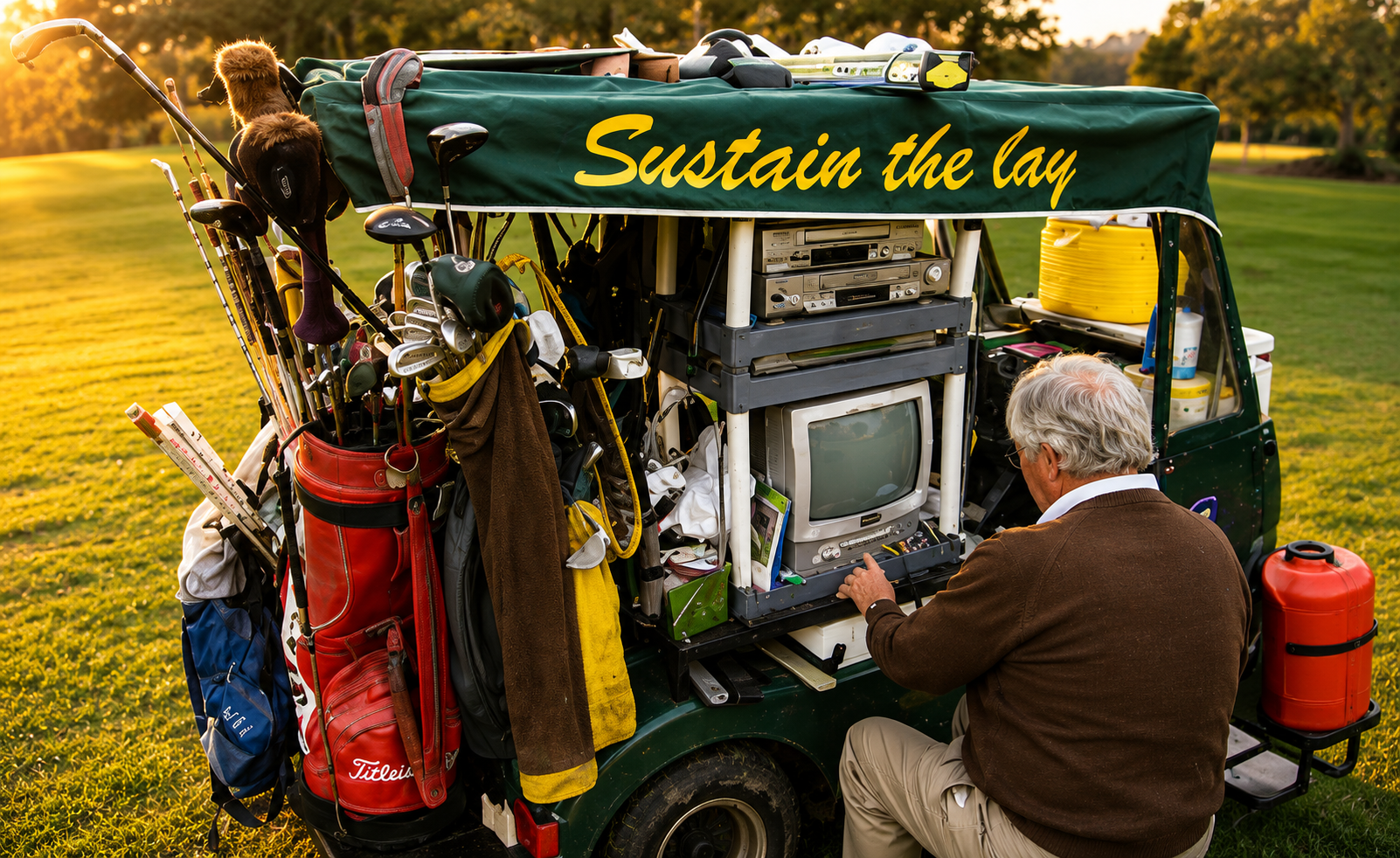
He also had an endless collection of sayings that his students affectionately called "Doylisms." They rarely made sense in the moment. You'd leave a lesson wondering what in the world he had been talking about, only to be standing over a shot three weeks later when one of those strange little phrases suddenly clicked. Those moments happened more often than I'd like to admit.
Ben: "What pushes the shopping cart?"
[long pause]
Me; "Well, your hands push the shopping cart"
Ben: "No, no...your legs pushing the shopping cart!"
Perfect Doylism right there.
The reason Ben's teaching was so different is that he wasn't trying to teach a golf swing.
He was teaching impact.
Everything traced back to what happened during the fraction of a second the clubface met the golf ball. The backswing only mattered if it helped produce a better impact. The follow-through was simply the reaction to what had already happened. Long before launch monitors, force plates, and high-speed cameras, Ben understood cause and effect with remarkable clarity.
Much of that understanding came from his mentor, Homer Kelley. Kelley, an engineer by trade, wrote The Golfing Machine, one of the most influential—and intimidating—books ever written about golf instruction. Most golfers couldn't make it through the first few chapters. Ben didn't just understand it; he brought it to life. Homer developed the science. Ben translated it into feels that ordinary golfers could actually experience.
That's what made him special.
He almost never talked about putting your body into perfect positions. Instead, he'd hand you one of his homemade training aids and let you discover the movement yourself. He believed that if you could feel the club correctly, your body would organize itself around that motion. It was a radically different approach then, and I still think it's one of the most effective ways to learn today.
As I've gotten older, I've realized Ben wasn't really teaching me mechanics.
He was teaching me how to think.
The more you understand what the golf club is supposed to do, the less you manipulate it. Ironically, that's the same philosophy every great caddy brings to a player. A great caddy doesn't overwhelm you with swing thoughts. He simplifies. Pick your target. Understand the conditions. Commit to the shot. Trust the motion you've built.
That philosophy has become one of the foundations of CaddyTips®.
Whenever I think about Ben today, I don't picture a perfectly manicured lesson tee or a polished academy. I picture that battered maintenance cart rumbling toward me, overflowing with strange homemade inventions. I picture the wildly overcomplicated practice mat that somehow contained a lifetime of golf knowledge. I hear another one of his Doylisms that wouldn't make sense until weeks later.
Most of all, I remember a teacher who cared far more about understanding the golf swing than marketing himself.
Ben Doyle never tried to build a brand.
He built better golfers.
And decades later, I still find myself hearing his voice over important shots, remembering lessons that began in that old maintenance cart at Quail Lodge Golf Club.
Looking back, I thought I was learning how to swing a golf club.
What Ben really taught me was how to understand the game.