
“Zero Clue of Strategy”: Faldo, DeChambeau, and What Links Golf Really Asks of You
If you caught Sir Nick Faldo on the Sky Sports Golf Podcast this week at Royal Birkdale, you heard a three-time Open champion say something that landed like a low 3-iron off firm turf: Bryson DeChambeau, he said, has “zero clue of strategy” when it comes to links golf.
It’s a spicy line. But underneath the headline is one of the clearest lessons in the game — and it explains why the golf we play here in the States can feel like a different sport than the one contested at The Open.
“I’ve never attacked a links.”
That’s the line that matters. DeChambeau built a brilliant career by attacking — more speed, more carry, fly the ball to a number and stop it. On a soft American parkland course, that’s a superpower. Faldo’s point is that a links doesn’t reward the attack; it rewards the thread. “You feed it down the fairway,” he said. You read the humps and bumps, send the ball over a slope, and let it nudge back into play.
Read that again, because it’s the whole philosophy. Links golf is played along the ground as much as through the air. The firm turf, the wind off the sea, the slopes and hollows — they aren’t obstacles to overpower, they’re tools to use. The great links player asks the ground to do half the work.
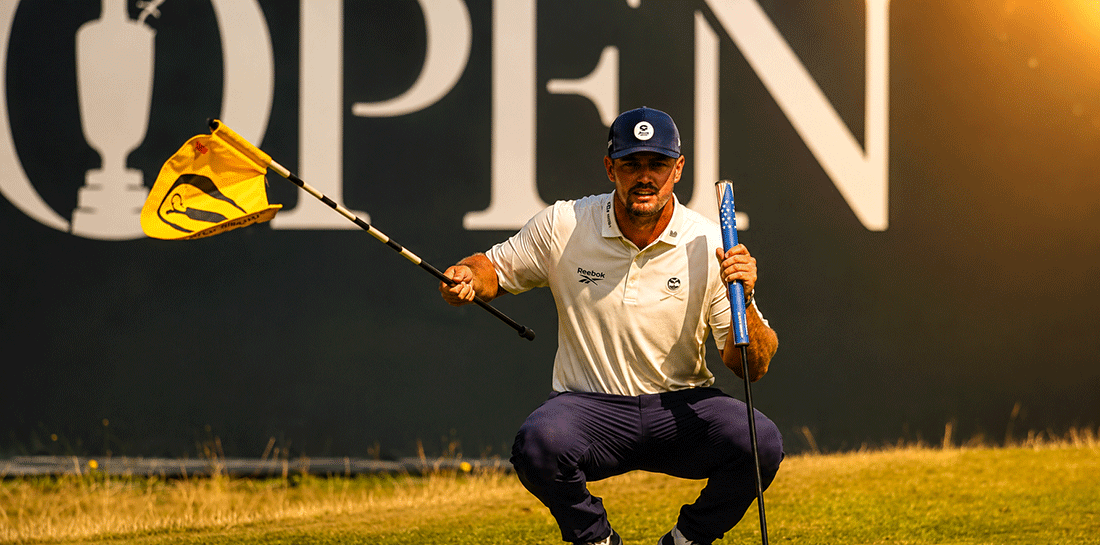
Work backwards from the green.
Faldo’s second key: plot every hole from the pin back to the tee, not the other way around. Where’s the safe miss? Which side feeds toward the flag, and which side runs away? Answer that first and the tee shot chooses itself — and often the answer isn’t driver at all. “I always used to look for all the downslopes,” Faldo said, “because you don’t have to hit the driver.” Land the ball on a downslope and the firm ground hands you 20 or 30 yards of free run — no need to squeeze a driver onto a fairway that might be 20 yards wide with a pot bunker lurking.
The margins are unforgiving — so play for position.
Here’s the detail that separates links thinking from target-golf thinking. Faldo noted that even a flushed drive can finish in the corner of a divot and miss the short grass entirely. When the bounce is that unpredictable, distance means little and position means everything. The question is never “how far can I hit this?” It’s “how do I get it onto the short grass, in the spot that opens up the green?”
That’s the American blind spot. We grow up flying wedges at numbers and spinning the ball to a stop. A links hands you a firm, running, wind-blown puzzle where the smart, position-first play beats the heroic one almost every time. Pot bunkers punish greed — you’re often chipping out sideways just to escape. The wind turns a stock 7-iron into anything from a 5 to a 9. And the player who threads it, uses the ground, and keeps the ball below the flag walks off with pars while the bomber is hacking out of the hay.
Faldo isn’t saying power is useless. He’s saying power without a plan is just noise. The links asks a sharper question — and the players who answer it are the ones lifting the Claret Jug.
Planning your own links pilgrimage? Our CaddyTips travel guides are built for exactly this moment — the American player stepping onto firm turf for the first time and realizing the ground game is the game. Inside, we break down how to actually play a links: when to leave the driver in the bag, how to putt from 30 yards off the green, how to flight the ball under a coastal wind, and how to treat a pot bunker as a hazard to steer clear of rather than a place to play hero.
We teach it through real courses — the humps and hollows of St Andrews’ Old Course, the blind carries and revetted bunkers of Royal Lytham & St Annes, the dunes of Royal Liverpool, and the honest, valley-routed fairways that made the Hawtree family and five-time Open champion J.H. Taylor legends of links design. Understand the architecture and the architect’s intent, and you stop fighting the course and start playing it — position first, par or better.
⛳ Explore the CaddyTips Links Strategy Playbook
Heading to Birkdale — or just want to watch The Open like a caddie? Here’s a taste of what our international caddie network will tell you about Royal Birkdale. Unlike most links, Birkdale sets its fairways down in the valleys between those towering dunes — which means cleaner sightlines, fewer lottery bounces, and a course that rewards the player who commits to a precise line and trusts it. That design is both a gift and a test: the dunes frame your target, but the revetted pot bunkers the Hawtrees carved into these fairways will cost you a full shot the moment you get greedy. Our caddies will have you thread the opening stretch, respect the wind that swirls around the 9th, and treat the par-3 12th — raised tee, deep hollow, four pot bunkers guarding a narrow green — with the pinpoint iron it demands. Then they’ll have you ready to pounce late, where the par-5 14th and 17th turn good position off the tee into real birdie chances and keep par-or-better firmly within reach. That’s the difference between merely getting around Birkdale and truly plotting your way around it. The full hole-by-hole game plan — every tee shot, every landing zone, every green — is waiting in your Royal Birkdale CaddyTips guide.