
Mind the Gaps: A Caddy’s Guide to Gapping Your Bag
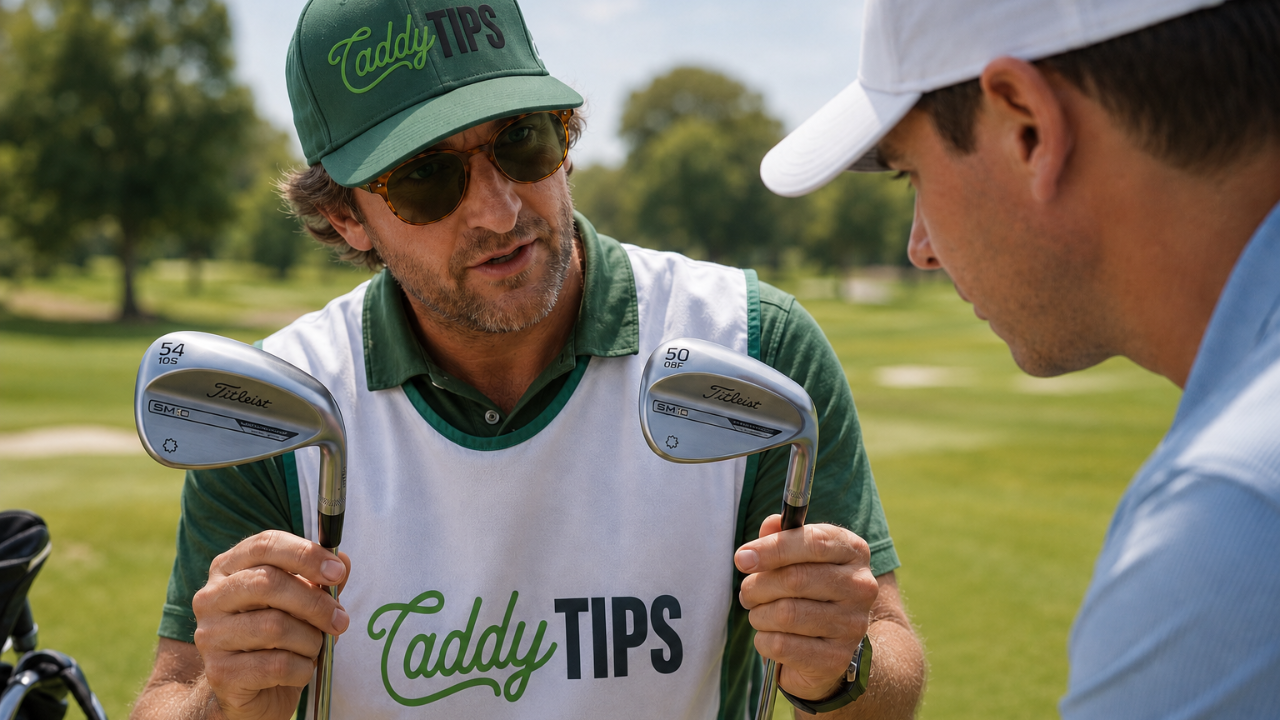
Hand a caddy your bag on the first tee and the first thing he does is look at what's in it. Not the brand. The "gaps". Because a caddie's whole job is handing you the right club — and if two of your clubs go the same distance while a 25-yard hole sits somewhere else in your bag, he can't do his job and you can't do yours.
Gapping is simply the spacing between how far you hit each club. Done right, every yardage on the course has a club that owns it. Done wrong — and it's wrong in most amateur bags — you're constantly stuck between clubs, guiding a swing you don't trust. That's where strokes leak out.
Here's the whole guide, and then the part that matters most.
---
The one rule: gap by carry, not by the number on the sole
Two things will save you before we go any further.
1. Carry distance is the only number that counts. Not the one great shot you hit in 2019. Not total distance with roll. Carry is where the ball lands, and it's the only thing you can plan a shot around.
2. The number stamped on the club is a marketing decision, not a measurement.** Modern iron lofts have been getting stronger for years — a "pitching wedge" that used to be 48° is now commonly 43–45°. Loft is what determines distance, so a 21° hybrid and a 21° iron aren't the same club; the hybrid can fly as much as 10 yards farther because the face is hotter and the shaft is longer. Ignore the numbers. Chase the yardages.
Your target: roughly 10–15 yards of carry separation between clubs. Any gap wider than 20 yards is a hole in your bag that's costing you shots every round.
---
Fairway woods: your one distance club, honestly assessed
The most common mistake at the top of the bag is carrying a 3-wood you can't actually hit off the deck. Be honest: if your 3-wood only comes out on the tee because you can't launch it from the fairway, it's not doing a full club's work.
+ Pick the longest club you can launch high enough to carry, then build down from there. Fitters generally look for about 4–5° of loft separation between long clubs — a 3-wood around 15°, a 5-wood around 18°, then a hybrid around 22°.
+ The 3HL is an underrated fix. A "3HL" is just a 3-wood with extra loft (16.5–17° instead of 15°). If your 3-wood is a tee-only club, swap it. You lose a few yards on perfect strikes and gain a lot on average ones.
+High-lofted woods are having a moment, and it isn't a gimmick.** The 7-wood and 9-wood were once dismissed as senior clubs. Then Tommy Fleetwood put a 9-wood in the bag at the 2026 Masters and called Augusta a perfect 9-wood golf course, saying he can't really hit a high 4-iron. Scottie Scheffler plays a 7-wood. The reason is landing angle: these clubs fly high and *stop* on a green from 200 yards, where a long iron lands flat and runs.
Hybrids: the problem-solvers
The hybrid isn't a longer club — it's a more reliable one. From a clean fairway lie, a fairway wood typically carries 10–20 yards farther than a hybrid of comparable loft. But from the rough, that gap narrows sharply, because the hybrid's smaller head cuts through grass instead of getting snagged.
+ The swap rule: if your 3- or 4-iron produces inconsistent results two rounds running, replace it with a hybrid of equivalent loft. Same distance, better consistency.
+Tighten your gaps here. Because club length and launch change so much in this part of the bag, many fitters go to 3° loft gaps for hybrids and woods instead of the 4° you use in the irons.
+Fairway wood vs. hybrid, simply: the wood is the distance club, the hybrid is the precision club. If you want to run the ball up from 220, take the hybrid. If you want to hold the green from 220, take the wood.
Irons: check for the crater
Irons are usually the best-gapped part of the bag, because they come as a matched set. But there's one trap: modern strong lofts create a crater at the bottom of the set. When a 44° pitching wedge gets paired with a traditional 56° sand wedge, that's a 12° canyon with nothing in it — which is exactly where we're headed next.
---
Wedges: the scoring zone
Now the part that actually moves your handicap.
Per Arccos data drawn from more than 150,000 golfers, shots from 100 yards and in account for roughly 65% of all strokes. Read that again. Two-thirds of your golf happens inside 100 yards. Yet most players spend their money at the top of the bag and their range time on the driver.
And here's a finding that should change how you think about laying up. Strokes-gained research from Mark Broadie found that for a golfer who shoots around 90, average proximity to the hole from 120 yards is 47 feet — while from 50 yards it's 23 feet. Less than half. The old saying "lay up to a full-swing yardage" is backwards. Getting closer is better, even when it leaves you a partial swing. You just have to own that partial swing — which is what the rest of this is about.
Step 1: Find out what your pitching wedge actually is
This is the foundation, and almost nobody does it. Your PW loft is stamped on the club or listed in the manufacturer's specs. Go look. Everything else is guesswork until you know that number.
Step 2: Build down in 4–6° steps
The rule is 4–6° between wedges, which typically produces that 10–15 yard carry gap you're after.
| Your PW | Gap Wedge | Sand Wedge | Lob Wedge |
|---|---|---|---|
| 44° | 48–50° | 54° | 58° |
| 46° | 50° | 54° | 58° |
| 48° | 52° | 56° | 60° |
If you only add one wedge, make it a gap wedge. It solves far more approach shots than a lob wedge ever will. Skipping it is why so many players are inconsistent from 90–110 yards — you end up asking your pitching wedge to cover a range it was never built for, and that's when you start guiding it and decelerating.
Two more CaddyTips® insider tips:
+ Wedges can be bent. A 50° can become a 49° or 51° for a few bucks. But every degree you strengthen the loft also removes a degree of bounce, so don't go wild.
+ Cap it at 58° unless you've earned the 60°.** The lob wedge is the most challenging club in the bag to hit consistently. If you're chunking or blading it more than about a third of the time, drop to a 58° — or just get better with your 56° first. The data backs this up: high handicappers lean heavily on 56° and 60° wedges, while better players build balanced 50/54/58 setups.
Step 3: Build your wedge matrix (the whole ballgame)
Three wedges don't give you three distances. They give you nine. This is the single highest-leverage practice hour in golf, and it's the one thing separating players who score from players who just hit it.
The clock system. Picture a clock face behind you and think of your lead arm as the hand. Address is 6:00. Take the club back to 7:30 (roughly half your full distance), 9:00 (about 75%), or 10:30 (about 90%). Same tempo every time — only the length of the backswing changes.
Calibrating it — one 45-minute session:
1. Start with your highest-lofted wedge.
2. Hit 5 balls at 7:30. Then 5 at 9:00. Then 5 at 10:30.
3. Record the median carry each — not the best one, the middle one.
4. Repeat for every wedge, then add your full-swing number.
5. Write all nine (or twelve) numbers on a card and put it in the pocket with your rangefinder.
That's it. One session. A dozen numbers you'll use for the rest of your golfing life.
A realistic matrix looks something like this — your numbers will be different, so use this as a shape, not a prescription:
| | 7:30 | 9:00 | 10:30 | Full |
|---|---|---|---|---|
| **PW (46°)** | 65 | 85 | 100 | 115 |
| **GW (50°)** | 55 | 75 | 90 | 105 |
| **SW (54°)** | 45 | 65 | 80 | 90 |
| **LW (58°)** | 35 | 55 | 70 | 80 |
Notice the overlaps — your SW at 10:30 and your GW at 9:00 cover nearly the same yardage. That's not a flaw, that's the point. Two ways to hit 80 yards means you can choose your trajectory: the sand wedge flies higher and stops faster, the gap wedge flies lower and releases. That's the shot-making a caddie gives you when he hands you a club and tells you what it'll do.
Step 4: Kill the deceleration
The number one reason amateurs miss wedge distances isn't talent — it's deceleration. You take a half backswing, it feels too big for the shot, and you unconsciously slow down through impact. Chunk. Or you panic-compensate and blade it.
The fix is counterintuitive and worth tattooing on your glove. Phil Mickelson — as good a partial-wedge player as has ever lived — pushes back on matching your backswing and follow-through, arguing you want to accelerate into the ball. His approach: take a shorter backswing than feels right, then commit and accelerate through it.
And when you're between numbers, do not swing harder. Take the longer clock position and swing it smoother. Or grip down an inch or two — that'll quietly subtract a few yards without changing anything else. Longer and smoother always beats shorter and faster.
---
Your gapping day: the checklist
1. Book 60 minutes with a launch monitor. Most decent ranges have one now. A rangefinder and honest range flags work in a pinch.
2. Hit 10 balls per club. Throw out the two best and the two worst. Average the rest. Your ego is not invited to this session.
3. Record carry only.
4. Write every number down, driver through lob wedge.
5. Find your holes. Circle any gap over 20 yards, and any two clubs going the same distance. One of those clubs is dead weight — replace it with something that fills a hole.
6. Laminate the card. Keep it in the bag.
Do that once, and you'll walk up to a 78-yard shot and know exactly what to do — instead of standing there wondering whether to kill a sand wedge or baby a gap wedge. That's not equipment. That's just knowing your own game.
And that's what a caddie is really giving you: certainty. You can carry your own.